
Paper #4 – PDF Copy
Paper #4: What Does The Future Hold For My Community?
By Ben Lynch (100153345)
English 100-36
What Does The Future Hold For My Community?
The future of my community will hold many beneficial changes and innovations. Canada is one of the most technologically advanced places on earth, and the speed of tech development will continue to grow. The future of pollution in Canada looks optimistic. Clean energy breakthroughs, and regulations in the next decade will help ease the situation. Canada is an extremely diverse country and I believe this trend will continue. The next generation will have access to a large amount of information and technology that we have never seen before. This leaves people with a large amount of power to potential to learn and grow. Access to this information will be beneficial for most, but negative for others
The future of technology will be much more advanced than today – Not just in Canada but the entire globe. Canada’s tech sector is thriving and continues to grow. The Canadian government has made “several significant investments to position Canada as a global leader in quantum research and development” (Pavlopoulos, 2022). Quantum computers are capable of solving complex problems far more quickly and efficiently than traditional computers. Quantum computers and AI will make a huge breakthrough in the next couple decades. AI is making a breakthrough in the education system, and may even take the place of paperback textbooks in the future.
Air, waste and ocean pollution will continue to be a crisis in Canada. Data shows that we can be optimistic about the future ecological state of the country. “By 2030 the world will experience a clean energy breakthrough to empower our world. As a result, solar, wind, hydropower and other sustainable sources are expected to account for half of our global energy mix by 2030.” (Canada, 2022) Other plans include Improved efficiency in “energy storage facilitates, and greater adoption of wind and solar.” (Canada, 2022). Although there are many plans in place, the room for improvement is massive. With the right implementation of rules and regulations, greenhouse gasses could be lowered significantly.
Finally, information for the next generation will be extremely easy to access. The next generation will also have more power to learn and grow than any other generation in history. Access to this information will be beneficial for most, but could lead to substance abuse and crime for others. There is more exposure to drugs for youth than ever before, and harmful lifestyles are becoming more common in society. The peer pressure may lead youth down a destructive path. According to teen substance abuse statistics, by the time Canadian students are in the 12th grade, the majority of them are drinking alcohol. “83% of 12th-grade students in Ontario admitted to drinking alcohol, with 49% confessing they binge drink.” (Venture, 2022).
In conclusion, predicting the future of my community with complete accuracy is unfortunately impossible. This question is extremely important to make sure we’re headed in a prosperous direction. I believe the future will hold many beneficial changes and innovations that will become mainstream in society. These changes will be both positive and negative. My one hope for the future is that the youth will not become too caught up in virtual realities that will take away from their success in the real world.
Resources
Marc Pavlopoulos, “Here’s What Life Is Like For Tech Who Want to Move to Canada.” Syndesus, July.14th, 2022. Retrieved from:
(No Author Given) “On the horizon: Several Perspectives on Canada’s technology future”. Government of Canada. April, 2021. Retrieved from:
(No author Name given) “Teen Substance Abuse statistics.” Venture Academy. May. 30th, 2022. Retrieved from:
(No Author Given) “About Renewable Energy”. Government of Canada. Dec. 13th, 2017. Retrieved from:
About Me
Hi, my name is Ben. I’m 20 years old living in North Vancouver and studying business at Capilano University. A sport that I enjoy is Freestyle Skiing. Currently I compete in Freestyle skiing on the BC Park and Pipe Team where I travel across North America to Compete in ski competitions.
My favourite subjects in school are math and physics, but I also enjoy english and history as well. When I grow up, I’d like to have a sales job and work as a general manager or a sales representative. I came from humbling beginnings which taught me many valueble life lessons. Skiing has taught me how to be goal orientated and grateful for the people around me. Here is my CapU ePortfolio.
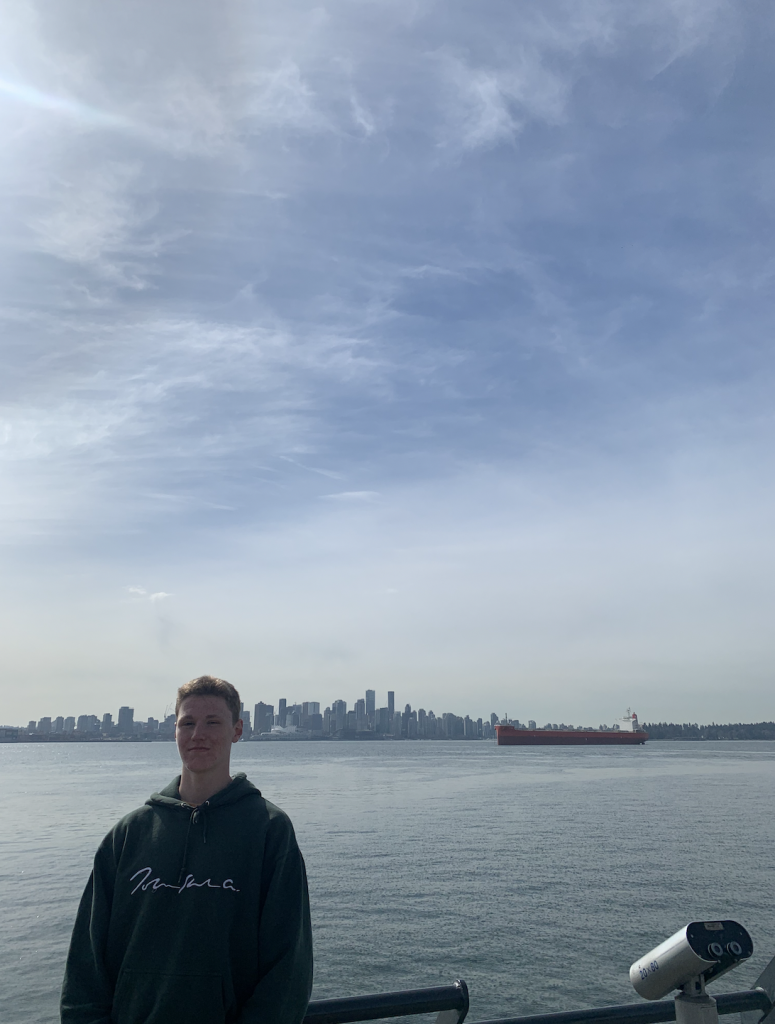
Four Images From My Community



Paper #3 – Suicide By Garbage: Solving The Pollution Crisis In Canada
By Ben Lynch (100153345)
ENGL 100-36
Canada has always been known as a relatively green and eco friendly country. However this is far from the case. Canada is a beautiful location home to outdoor enthusiasts, and morally correct people – for the most part. We can see this with the ongoing support of the green party. Canada, however, suffers from one of the most overlooked problems on the planet. This paper will examine the pollution crisis at a larger scale, then will dive into two particular solutions to the crisis. It’s important to note that almost every person is aware of the pollution crisis; it’s not that the problem doesn’t have exposure. People are not directly affected by the pollution crisis in their everyday lives, and quite frankly, don’t know what to do about it. Therefore, it goes over the radar for most people. However, we are approaching a state that could potentially be irreversible. Now, there are many things that will not change. Canadians tend to think that if more countries were like Canada, the planet could be saved. However, if every country was like Canada, in terms of all-out consumerism and waste, the world would be in even more crisis than anticipated. In this paper, I’m going to talk further about the waste crisis that Canada is facing. Moreover, I will propose several solutions to the crisis that could help put our ecosystems back on track.
To begin, the underlying problem of pollution is a very difficult one to solve. I noticed this the more I researched about the topic, and discovered the flaws of the pollution argument. There is without a doubt a huge problem of pollution, and it’s growing every year. Many radical claims state that the pollution crisis is a catastrophic mess. A recent title from NPR reads that “Earth has 11 years to cut emissions to avoid dire climate scenarios.” (Neuman, 2021)
See, climate change is a real bottleneck, because you have to assume certain metrics when it comes to predicting the future of action we take today. The errors will accumulate and grow massively. Therefore, it is very hard to measure what the effect of pollution will have on the planet in the future. So how can you make a valid claim when you can’t even accurately measure the future effects of the pollution problem? And even then, what are we going to do about it? Switch to wind and solar?
However, It’s very difficult to separate science from the politics. (Peterson, 2019) Even if the radical claims are true, there is little we can actually do about it. Switching to wind generated power is a common solution/idea that is often brought forwards. However, with this method “you can’t store the power. Germany tried it, they produced more carbon dioxide than when they started because they had to turn on their coal fired plants again.” (Peterson, 2019) Many of these so-called solutions actually introduce more issues than in the first place. Another point that makes pollution a hard topic is, “A multiplicative error structure, common in air pollution exposure estimates, can alter the shape of the exposure-response curve.” (Girguis, 2021) This means that the data points that contribute to pollution are unreliable, and will ultimately hold errors. Climate change projections/claims are quite unreliable to begin with. The unreliability of the measurements magnify as you move forward in time as the errors accumulate. Therefore, we can’t even accurately measure the effects that climate change will have on our planet, or anything we do right now. This is a massive flaw in the radical eco-friendly claims.
All things noted, there is definitely still a problem. It may be a very sticky one, with no clear resolution, but this adds to why I believe pollution will be the most significant problem we will face in the 20th century. Canada plays a large role in the production of waste in particular, which is why our community needs to step up and make a change. Studies say, “Our production is seven per cent higher than per capita output of waste in the United States.” (Hird, 2017) The garbage deposit is larger than anywhere else on the planet in Canada per person. Without change, the problem will spiral out of control. Garbage dumps are so big that workers at the dumps call them “lakes or oceans. However these oceans aren’t filled with water, but garbage.” (Hird, 2017)
Canada has the leading amount of garbage waste per person on the entire planet, and this is not something to be proud of. “Canada leads the developed world in per capita production of garbage.“ (Wilkinson, 2017) According to officials, a “never-ending avalanche of recyclables that pours into the facility at a rate of about two tonnes a minute.” (Wilkins, 2017) In fact, some people are even quoting the problem as, “suicide by garbage,” (Harrison, 2017). Even more scary is the unawareness of the problem. Professionals say waste companies “deal with its municipal waste so efficiently that the average person doesn’t see how much of it there is or where it goes. Out of sight, out of mind, sort of thing” (Hird 2017). The 720 kilos per capita of waste produced annually by every Canadian is about twice what is produced per capita in Japan and as much as 10 times what is produced by a half-dozen countries in Africa (Pg. 7). Ontario is the worst province in Canada, racking up an alarming “200,000 tonnes of recyclables”. Its residents produce household garbage (the stuff we put in green bags) at a rate of 10,000 tonnes a week, or half a million tonnes a year (Pg. 7).
On the contrary, Canada’s source of energy is for the most part renewable and eco-friendly. “From 1989 to 2017, the number of coal mines in Canada decreased by almost 50%.” (Statistics Canada, 2020). Unfortunately, energy sources like Solar are not the most effective in countries like Canada because of the high altitudes. Unlike countries like Australia with over %15 of their energy coming from solar, “ESPC data shows that solar panels in Canada generate significantly more electricity in the spring and summer than they do in the fall and winter.” This means the amount of sunlight received by solar panels is highly seasonal, making it inefficient. Today, “Solar PV electricity currently accounts for less than 1% of our total electricity production.” (Government of Canada, 2022) Although solar powered energy may not be the most effective option, hydro electricity is the major production energy in Canada. The natural flow of water in rivers offers kinetic power that can be transformed into usable energy. Currently, “more than half of the electricity in Canada (60%) is generated from hydro sources.” (CER, 2022). Hydropower plants can generate power to the grid immediately, and provide essential backup power during major electricity outages or disruptions.
The first solution that seems obvious is to introduce a charge for waste per person in Canada. This has already been introduced in England where they charge you if you exceed the maximum monthly waste amount. This incentives people to use less waste. This should also be introduced for businesses. Even though there will be a large pushback, especially for the biased media, it will be the most sustainable route forwards for Canada. “Variable waste charging provides an incentive for households to reduce their waste and recycle more” (Dresner, 2010) This solution is most effective for domestic use, and is “Since 2010, the volume of waste collected per person has fallen by roughly six percent.” (Statista 2020). England introduced the law in 2015, “Before then over 7.6 billion single-use carrier bags were given to customers by major supermarkets in England during 2014.” Therefore the law largely cut down domestic waste in the country. Large companies could use some sort of reward or incentive program for using less packaging
Although Canada may not have the best source for solar powered energy “All regions of Canada have hydropower resources available for development, making it a truly national resource. With a reservoir to store energy, hydropower becomes more flexible than any other energy source and can support the integration of other renewable but variable power sources such as wind or solar power.” (Canada Hydropower Association, 2022). This makes hydro power a no-brainer solution for canada. Although there are many drawbacks such as risky infrastructure, the potential energy that could be created with hydro-powered plants is the highest in Canada than any other place on earth. Therefore, this would be a huge step in an economically sustainable country.
These are also two solutions that won’t cut off businesses from making money. Solutions such as nuclear and wind to replace coal fired plants are a recipe for disaster. However there are some precautions we can take, one being: charge money for waste. Another being the construction of more hydro plants in Canada. Why? People will use less waste, there will be less waste sent to the incinerator, and less harmful chemicals will end up in our atmosphere.
The topic of pollution is important because it will directly affect our ancestors, and the future of the planet. Canada needs to introduce a domestic waste cost to combat the waste problem and introduce more Hydro-plants around the country to combat greenhouse gasses being released into the environment. Although Canada already has many eco-friendly energy sources in place, there is still a huge margin for improvement in these categories. With the right reach, people will become more aware of the possibility and benefit of a greener, and more sustainable country.
Works Cited
Charles Wilkinson, “Canada leads the developed world in per capita production of garbage. An exclusive investigation into the nation’s dirtiest“ TransNation. Retrieved from:
(No Author Given), “Job Displacement in Coal Mining in Canada” Statistics Canada. Retrieved from:
https://www150.statcan.gc.ca/n1/pub/11-627-m/11-627-m2020023-eng.htm
(No Author Given), “5 Things You Need To Know About Hydropower – Canada’s Number One Electricity Source.” Canada Hydropower Association. Retrieved from:
(No Author Given) “Job Displacement in Coal Mining in Canada.” Statistics Canada. Dec. 15, 2020. Retrieved from:
https://www150.statcan.gc.ca/n1/pub/11-627-m/11-627-m2020023-eng.htm
“Market Snapshot: Solar Power Generation in Canada is Highly Seasonal” Canada Energy Regulator. June. 30, 2022. Retrieved from:
“Here Comes The Sun – Power The Future of Renewable Energy.” Government of Canada . May. 2022. Retrieved from:
https://www.nrcan.gc.ca/simply-science/here-comes-the-sun-powering-the-future-renewable-energy/24293
“Solar Power by Country 2022”. World Population Review. 2022. Retrieved from:
https://worldpopulationreview.com/country-rankings/solar-power-by-country
Simon Dresner “Charging for domestic waste in England: Combining environmental and equity considerations” October 2010. Retrieved from:
https://www.sciencedirect.com/science/article/abs/pii/S0921344910000650
“Carrier Bags: Why Theres A Charge” May. 21, 2021. Retrieved from:
Paper #2 – Canadian Media Bias Towards Business Interests
By Ben Lynch (100153345)
ENGL 100-36
The increase in minimum wage has been a big topic of conversation over the past decade. In 2018, Alberta and Ontario increased the minimum wage to $14 in 2018, and $15 by the following year. Although this increase has proven little to no impact on businesses in Canada, the media creates their own narratives. There was a prominent narrative created around the increase in minimum wage that was heavily skewed towards the interest of businesses, rather than labor unions and workers. This narrative is a great example of how the media can create huge biases when it comes to public information.
Press progress wrote an article about the biased media coverage during this period explaining that, “three quarters of all news coverage (75%) between December. 31st, 2017 and January 4th, 2018 greeting the new minimum wage – including news reports, opinion columns and editorials – directly quoted or cited figures from business owners, bankers and corporate lobby groups.” (Press Progress, 2018) Fewer than one-third of all news articles cited sources like unions, labor economists or even low wage workers themselves.
The title of the article I chose is “Small business owners brace for impact as Ontario minimum-wage hike takes effect.” (The Globe and Mail, 2018) This title alone has a lot of framing or built in assumption behind it. It seems to suggest that all small business owners are “bracing for impact”, when this isn’t the case at all. In reality, “although there’s 400,000 small businesses in Ontario, reporters from The Globe and Mail only got in touch with 14 of them.” (Press Progress, 2018) One of the most mentioned businesses in this article was “Kaboom Chicken” who had previously criticized the minimum wage hikes on instagram. This is something that media outlets seem to do often. They find certain businesses that are public about their political positions on social media, and go running to them to get they’re opinion. They then proceed to act as though they are representative of the entire industry. Although there are 400,000 small businesses in Ontario, they only spoke to 14 of them, one of which was publicly criticizing the minimum wage hike.
There was another number which was being thrown around a lot in the media during this period. An article written in 2018 titled, “Minimum wage hikes could cost Canada’s economy 60,000 jobs by 2019.” (CBC News, 2018) There is not much data to prove this number is true. In fact, history has shown us that when there is an increase in minimum wage, there isn’t an increase in job losses at all. In the media there seems to be a hyperfocus on business interests rather than the vast majorities of people and the actual workers themselves.
Trends in the media show that there is bias framing of media coverage. Oftentimes the built in assumption of blame is on the minimum wage itself, instead of focusing on: Why can’t these businesses properly pay their employers an actual living wage? This is not a problem of the minimum wage, it’s more a problem of businesses who are not capable of handling the increase. Maybe their pricing is too low, or maybe the executives in these companies are making too much money. Instead, the blame falls on the rise in minimum wage. A financial post article headline reads: “Ontario’s minimum wage hike off to a rocky start as employers slash hours, benefits to compensate.” (Financial Post, 2019) This title is framed to put the blame on the minimum wage rather than the businesses themselves.
The rhetoric within my chosen article is that the minimum wage is a groundbreaking change for many small business owners, but fails to take into consideration the low wage workers’ problems. Press Progress did an amazing review on the media coverage during this period. They found, “53% of articles they reviewed cast businesses as the victims of the story, frequently highlighting ways businesses will struggle as a result of raising the minimum wage. By contrast, only 14% of all news articles highlighted ways low-wage workers are already struggling to make ends meet.” (Press Progress, 2018) In addition, two thirds of voters in Ontario at the time were in favor of the increase in wages. However, none of this was shown in the media coverage. This proves that the media is not representing the majority of people, but business interests instead.
Recent history shows that there has not been a negative impact on jobs due to increase in the minimum wage. In fact, provinces like Alberta have a history of labor shortage at the low end of the wage scale. A higher minimum wage will actually make these jobs more attractive. “Raising the minimum wage increases overall consumer spending power and the amount of money circulating in the economy.” (Globe & Mail, 2019) A minimum wage increase is rather a stimulus to the local economy. This is because when low income earners gain money, they are more likely to spend their money in the local economy. On the contrary, if you put more money into the hands of wealthy people, it goes back into the bank. Or maybe they’ll spend money on a trip to another country. Therefore the rise in minimum wage should be seen as a benefit.
To conclude, there is always going to be this narrative of corporate interest over everything else. Whether you like it or not, the large corporations are the ones who control the media – they are able to push certain narratives that benefit themselves. Whereas, unless you’re in a union, the regular low-medium income worker’s narrative is not being pushed on the media. This is why we see most media articles in the interest of businesses rather than the interest of the vast majority of people. We can see this in Ontario, as the majority of people actually support the minimum wage increase. This article exposes how out of touch the media is with the everyday person.
Works Cited
(No Author Name Given). “News Coverage of Ontario’s Minimum Wage Was Slanted Heavily Towards Business Interests.” Press Progress. Feb. 2 2018.
Thomas Rueters. “Ontario’s minimum wage hike off to a rocky start as employers slash hours, benefits to compensate.” The Financial Post. Jan. 9, 2018.
Pete Evans. “Minimum wage hikes could cost Canada’s economy 60,000 jobs by 2019.” CBC News. January. 3, 2018.
https://www.cbc.ca/news/business/bank-of-canada-minimum-wage-1.4469912
Selected Article
Brenda Bouw. “Small business owners brace for impact as Ontario minimum-wage hike takes effect.” The Globe and Mail. Jan. 1, 2018.
Paper #1 – The Pollution Crisis in Canada
By Ben Lynch (100153345)
ENGL 100-36
Canada is one of the most beautiful and ecologically significant places on earth. Seeing the natural beauty of this country being destroyed by the growing problem of pollution is a hard pill to swallow. Right now, we live in an era where short term financial gain is put ahead of the long-term wellbeing of the planet. Canadians value the cleanliness of the country and the beautiful outdoors but we don’t seem to be able to control the habits that are fundamentally and irreversibly damaging the environment. This is a problem that will affect us, and all future generations if we don’t do something about it. The main types of pollution in Canada are air pollution, ocean pollution, deforestation and waste.
Coming from a skiing background, I greatly value the freezing-cold winters and heavy snowfalls. Rising temperatures are a huge problem that threaten the future of all snow sports. This would be a huge disappointment to many people just like me. I hope to be able to share the joy I get from skiing with the next generation. Although Canada is generally thought of as a clean country, with ‘green’ principles at heart, the reality doesn’t reflect those viewpoints. “Air pollution is linked to an estimated 15,300 premature deaths every year.” (Canada, 2022). So what is causing air pollution in Canada? According to Canada.ca, “In 2020, about 24% of Canada’s total greenhouse gas emissions came from the oil and gas sector, 22% from transportation, 12% from buildings and 10% from the heavy industry sector.”(Canada, 2022). This results in roughly ⅔ of all air pollution coming from big industry, and ⅓ coming from residential emissions. Another huge contributor to Canadian air pollution are the oil sands. Oil sands are a sludgy deposit of sand, clay, water, and sticky, black bitumen used to make synthetic oil from strip mining. The race to generate money from strip mining started in the early 1990’s. Oil sand operations currently emit roughly 70 Megatonnes (Mt) per year in Canada. However, since then research has been done on how these oils affect our air quality when extracting it. They found that the oil from tar sands is one of the most destructive, carbon-intensive and toxic fuels on the planet. “Producing it releases three times as much greenhouse gas pollution as conventional crude oil does.” (Love, 2020) Oil sands are a huge industry in Alberta and will continue to pollute our air if we don’t stop. There is currently no limit on oil sand extraction, either by facility or industry-wide.
Ocean pollution is another growing problem that is a threat to the environment and to human health. Ocean pollution build up comes from a variety of sources such as industrial waste, agricultural runoff, pesticides, and human sewage. People may be exposed to, “HAB toxins from eating contaminated fish and shellfish. These toxins can cause dementia, amnesia, other neurological damage, and death.” (Avakian, 2021) Today, ocean pollution is most problematic in southern parts of Canada. I interviewed Steve, a kayaking enthusiest who lives in Squamish. He told me that, “most of the pollution build-up is not just plastic, but fishing nets.” (Best, 2022) Fish netting is the most dangerous waste because, “the netting can tangle around the neck of fish and other animals and strangle them to death!” (Best, 2022). Another dangerous type of waste for ocean wildlife is plastic water bottles: “The water bottle will decay over time into thousands of pieces small enough that the fish will actually mistake the plastic decay for food.” (Best, 2022). I also spoke with my cousin, Dr. Bryson Robertson, who experienced the problem first hand. In 2007, Byson, his brother, Ryan and a friend sailed around the world to bring awareness to the problem of ocean garbage. On their journey, they conducted a study of garbage on beaches. On Fakarava, part of the Marquesas Islands, they collected waste from a 100 metre section of beach and found a total of, “84 pop bottle caps, 3 large chunks of styrofoam, and 15 random pop bottles.” (Robinson, 2007). In total they collected just under 200 pieces of plastic from that 100m stretch of beach. Dr Robertson went on to complete his Phd on the issue and to publish a dissertation on Wave Energy.
Thirdly, another factor to the global warming crisis in Canada is deforestation. Although deforestation only accounts for a small amount of greenhouse emissions in Canada, forests play a critical role in regulating greenhouse gasses in the atmosphere. Canada holds 9% of the world’s forests with the Boreal forest being the largest in the world. Along with its size, it also holds the leading amount of potential carbon emission storage anywhere in the world. “The Boreal Forest is the Earth’s largest terrestrial carbon storehouse, storing 208 billion tons of carbon, or 11% of the world’s total.” (Drever, 2022) To further prove my point, these forests are a part of a natural cycle that produce rainfall. If you cut down the forest, the lack of rainfall will add to the global warming problem. A recent example of this phenomenon is happening currently in Brazil, where the Amazon Rainforest is being cut down rapidly. Scientists say, “the Amazon rainforest is estimated to harbor about 76 billion tons of carbon.” (Leuzinger, 2020) If all trees were cut down and burned, the forest’s carbon storage capacity would be lost to the atmosphere. For comparison, humans emit about 10 billion tonnes of carbon every year through the burning of fossil fuels.
Finally, a big factor of pollution in Canada is due to garbage/waste. I see this as the largest issue in Canada today because the stats show it. Canadians produce more garbage per capita than any other country on earth. Canadians generate an estimated, “1.33 billion metric tons of waste per year, with 1.12 billion metric tons of this generated by industrial waste.” (Statista, 2019) I have experienced this problem first hand. Often when I’m on the road traveling to a ski competition, we have to get fast food on the road. The amount of packaging you receive with your food is excessive. “Canada produces 777 kilograms of garbage per citizen. Across all 17 countries studied, the average was only 578 kg per citizen.” The numbers show that Canada produces more than twice as much garbage, per person, than Japan, the best country on the ranking in that category, which recorded only 377 kilograms per person that year.” (Statista, 2019) My father chatted to me about the crisis, and he claims to know the cause of this problem. “Countries in the EU all have a strict pay-per-garbage law that prevents them from disposing of too much waste at once.” (Lynch, 2022) This makes them more mindful about the waste they do throw out. “Each person will have a chip that’s embedded into their trash can, and when the garbage truck comes to pick up their trash, it weighs their trash and charges everyone accordingly at the end of the month.” (Lynch, 2022) Currently there are no regulations or charges against the amount of waste you can produce in Canada. Although Canada is one of the best countries at cleaning up, this doesn’t mean we are good in terms of the waste we produce. “Emissions from Canadian landfills account for 24% of national methane emissions.” (Canada, 2022) The amount of waste that goes to the incinerator is equal to the volume of greenhouse gasses going into the atmosphere. On the upside, a lot of this waste is recycled and created into renewable energy.
To conclude this paper, I thought I would also play devil’s advocate. There are many people who say that the global warming crisis is a natural cycle of the planet. They claim that the climate has always been changing. Over the course of the Earth’s 4.5-billion-year history, the climate has changed a lot. This is true. But the rapid warming we’re seeing now can’t be explained by natural cycles of warming and cooling. The kinds of changes that would normally happen over hundreds of thousands of years are happening in decades. “Global temperatures are now at their highest since records began. In fact, 17 of the 18 warmest years on record have all taken place since 2001.” (Liodden, 2019) This means that there is strong evidence that pollution is the cause of the global warming crisis.
Global warming is a problem that is vastly overlooked by most people. This matters because the future health of our planet is our responsibility, and if we can’t change soon it may be too late. We need to protect and sustain life on planet earth, by ceasing or mitigating the habits – personal and industrial – which are damaging the environment. Most people are too caught up in their first-world problems and fail to see the outcome of their choices and habits. Through my own experience, I have seen the disregard for Mother Nature get worse. I have seen more garbage on the side of highways, and the ski seasons get shorter each year. Personally, I think people need to wake up and take a stand against pollution. Canada needs to put more laws in place to stop pollution, and use more renewable sources to create energy. Currently, “less than 2% of all energy in Canada is created with renewable sources.” (Capp, 2022) The symptoms of this problem is a dying planet which we can never recover from. This is why I believe pollution is the most critical issue affecting my community.
Works Cited
Love, Valerie. “No Tar Sands.” Center of Biological Diversity. (No date provided). Retrieved from:
Denchak, Melissa. “The Dirty Fight Over Canadian Tar Sands Oil.” NRDC. December. 31, 2015. Retrieved from:
Avakian, Megan. “New Study Finds Ocean Pollution a Threat to Human Health”. National Institute of Environmental Health Sciences. February, 2021. Retrieved from:
Duhaime, Audrielle. “Canada’s oil sands are a major source of air pollution, airplane study shows.” The Verge. May. 25, 2016. Retrieved from:
Waats, Jonothan. “The Amazon rainforest will collapse if Bolsonaro remains president.” The Guardian. July. 14, 2021. Retrieved from:
Leuzinger, Sebastian. “Climate Explained: what would happen if we cut down the Amazon rainforest?” The Conversation. November.17, 2020. Retrieved From:
(No author name given). “Canadians produce more garbage than anyone else.” CBC News. Jan.17, 2013. Retrieved from:
https://www.cbc.ca/news/business/canadians-produce-more-garbage-than-anyone-else-1.1394020
(No author name given). “Waste.” Community Research Connections – Sustainable Community Development. Feb.14, 2014. Retrieved from:
Tiseo, Ian. “Estimated annual waste per capita of the leading waste producing countries worldwide as of 2019”. Statista. August.24, 2021. Retrieved from.
https://www.statista.com/statistics/1168066/largest-waste-producing-countries-worldwide-per-capita/
Drever, Ronnie. “How Canada’s Boreal Forest can be a powerful solution for climate change.” Nature United. (No date given). Retrieved from:
Cambridge University. “Deforestation in Canada, What are the facts?” Natural Resources Canada. March, 2016. Retrieved from:
https://cfs.nrcan.gc.ca/pubwarehouse/pdfs/36710.pdf
Jorgen Liodden, Ole. “Here are 10 myths about climate change.” WWF. September, 2019. Retrieved from:
https://www.wwf.org.uk/updates/here-are-10-myths-about-climate-change
(No Author Provided). “Canada’s Energy Mix.” Capp. (April, 2022). Retrieved from:
capp.ca/energy/canadas-energy-mix/
Robertson, Bryson. “OceanGybe Beach Garbage Study, Fakarawa atoll, Tuamotu’s.” OceanGybe. Sept.30, 2007. Retrieved from: