
Emotional development is one of five scales measured by the Early Development Instrument (EDI), a Canadian found instrument that studies the states of development in children. These five scales are emotional maturity, social competence, language and cognitive skills, physical health and well-being, and communication skills. Emotional maturity focuses on a child’s emotional development in terms of behavior, focus, hyperactivity, aggression, etc.
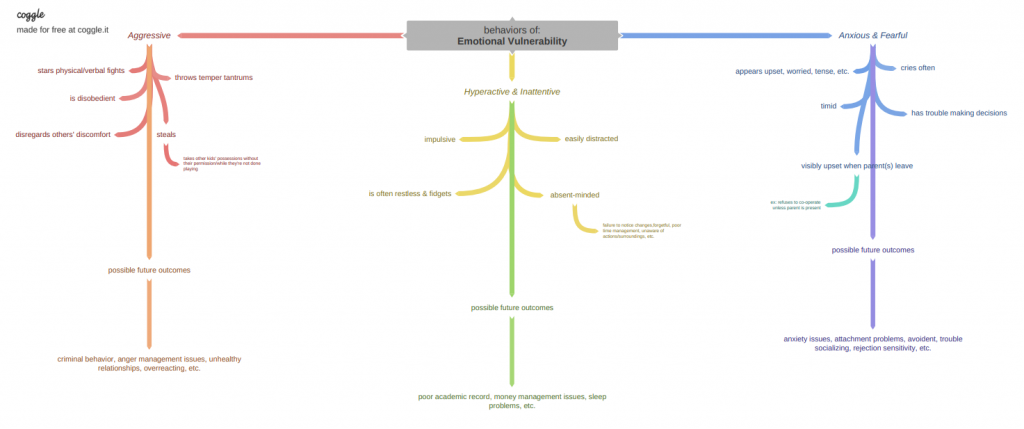
The importance of EDI is that it gives an insight as to how children may show signs of healthy or unhealthy development along with their possible life-long impacts, their overall mental health and well-being, and how caretakers can help assist an ideal growth. Below attached is my essay on how risk and resilience affect emotional development, as well as a mindmap to highlight notable traits found in emotionally vulnerable children and their possible outcomes if the child goes untreated or assisted.
There are many programs and interventions to assist caregivers and educators in promoting healthy development for the children in their lives. A program I have found much interest in is one held in Spain, regarding how much emotional development can impact students in their academic life as well as personal.
The EDI program promotes resilience by teaching children how to understand and express their emotions through a series of highly beneficial activities for a developing brain. This program is an intervention program targeted specifically toward promoting academic achievement through improved emotional intelligence for children. Conducted by María-José Cantero, Raquel Bañus, and Paz Viguer, the study was aimed at 10-12-year-olds in Spain in two years. The EDI program took place during homeroom time and consisted of a fictional character named EDI and their journey through emotion through four
modules: intrapersonal skills, interpersonal skills, emotion regulation, and general mood (p.12).
Children were taught to recognize and apply emotions in everyday life. The writers, and conductors of the program, describe their process as “a comprehensive approach that includes experiential methodology with psychophysical, psychodrama, and systemic techniques, as well as some cognitive-behavioral techniques. The structure of the intervention
was based on techniques such as film forum, storytelling, drama, group discussion, case studies, relaxation, and music therapy. We also used techniques such as empathic stimulation, active listening, positive reinforcement, and modeling to strengthen learning.” (p. 12). The aim of to program was to see if improvement in emotional intelligence would also improve academic intelligence. According to the received data, students who attended the program scored better in language and mathematics compared to the students who didn’t participate.
References
Bañuls, R., Cantero, M. J. & Viguer, P. (2020 October 19). Effectiveness of an
Emotional Intelligence Intervention and Its Impact on Academic Performance in Spanish PreAdolescent Elementary Students: Results from the EDI Program. PubMed Central.
https://www.ncbi.nlm.nih.gov/pmc/articles/PMC7588891/
What piqued my interest in this study were my own troubles with emotion regulation and how they affected my academic life. Something as simple as having a reading break before a class to help me gather my thoughts has always been helpful, a skill I have learned perhaps a little too late for it to stick. Even in BC, the EDI provincial report shows an intriguing Wave 7 (2016 – 2019) report. Comparing Lonsdale (North Vancouver) and James Bay (Greater Victoria), the emotional vulnerability scale appears to be a little higher than average in James Bay (James Bay 21%, average in Greater Victoria 17.7%); while Lonsdale has the highest vulnerability rate compared to the rest of the neighborhoods in North Vancouver with a 36% vulnerability in a 33.4% average.
With the spread of technology and the impacts of recent events, promoting such helpful programs could strengthen the well-being of future generations.
References
Human Early Learning Partnership. EDI BC. Early Development Instrument
British Columbia, 2016-2019 Wave 7 provincial report. Vancouver, BC: University
of British Columbia, Faculty of Medicine, School of Population and Public
Health; 2019 Nov. Available from: http://earlylearning.ubc.ca/media/edibc_
wave7_2019_provincialreport.pdf