
It has been a long time since I’ve used this tool. To be completely honest, I forgot it existed. That’s ADHD for you. It’s a little unnerving to see my past work and see little to no difference. I plan on graduating Fall 2024 or Spring 2025. I don’t know what I’m doing, and I’m scared. Hopefully using this eportoflio to plan will help put my mind at ease. First, I need to remember and master using it, wish me luck!
Emotional Maturity & Academics (2.0)
Emotional Maturity & Academics
Early childhood is inarguably one of the most precious parts of our lives. We are creative, curious, optimistic, accepting… but also highly vulnerable. Early childhood is when we become more aware of ourselves and our surroundings, and if our surroundings are harmful, they can have lasting effects. In this important stage, our genes and environment begin to shape our personality, our views, and even have a tremendous effect on our future. This is why, aside from obvious ethical reasons, childhood must be handled with care. This post will focus particularly on the development of emotional maturity during childhood and its effects on academic achievement.
EDI
The Early Development Instrument (EDI), found by the Human Early Learning Program (HELP), is a Canadian found instrument that studies the states of development in children. This publicly available instrument allows access to vulnerability rates of children in each province, city, and neighborhood in Canada, according to the five separate scales of development it studies.
These five scales are:
- emotional maturity
- social competence
- language and cognitive skills
- physical health and well-being
- communication skills.
Each of these five scales are then studied in terms of their domain, ideal development, signs of vulnerability, and possible outcomes. With the help of EDI, HELP is able to determine who is at risk on which scale to improve assistance.
Emotional Maturity & Vulnerability
This post’s scale of interest, emotional maturity, focuses on a child’s emotional development in terms of their behavior, emotion management, and appropriate response/approach to unique circumstances. HELP identifies four subscales for emotional maturity.
These four subscales are:
- aggressive behavior
- anxious & fearful behavior
- hyperactive & inattentive behavior
- prosocial & helping behavior
These subscales allow a closer look into the causes, treatments, and possible outcomes. The latter, prosocial & helping behavior, can be held as the ideal outcome. A child’s ability to respond rationally, have a better grasp of their emotions, and show support to those in need can be promoted by positive role models and resilience (ability to process and cope with negative experiences). The mind-map below shows the possible outcomes if a child exhibiting signs of the first three subscales do not receive any support or intervention:
How to Help
As someone who relates to the anxious & fearful subscale a little too much, I can confirm that the “possible future outcomes” are embarrassingly accurate. Not only can these traits cause issues in personal life, but in academic performance as well. So, is there a way to prevent this?
There are many programs and interventions to assist caregivers and educators in promoting healthy development for the children in their lives. A program I have found much interest in is one held in Spain, regarding how much emotional development can impact students in their academic life and how it can be treated.
The EDI program promotes resilience by teaching children how to understand and express their emotions through a series of highly beneficial activities for their developing brains. This program is an intervention program targeted specifically toward promoting academic achievement through improved emotional intelligence for children. Conducted by María-José Cantero, Raquel Bañus, and Paz Viguer, the study was aimed at 10-12-year-olds in Spain in two years. The EDI program took place during homeroom time and consisted of a fictional character named EDI and their journey through emotion through four
modules: intrapersonal skills, interpersonal skills, emotion regulation, and general mood (p.12).
Children were taught to recognize and apply emotions in everyday life. The writers, and conductors of the program, describe their process as “a comprehensive approach that includes experiential methodology with psychophysical, psychodrama, and systemic techniques, as well as some cognitive-behavioral techniques. The structure of the intervention
was based on techniques such as film forum, storytelling, drama, group discussion, case studies, relaxation, and music therapy. We also used techniques such as empathic stimulation, active listening, positive reinforcement, and modeling to strengthen learning.” (p. 12). The aim of the program was to see if improvement in emotional intelligence would also improve academic intelligence. According to the received data, students who attended the program scored better in language and mathematics compared to the students who didn’t participate.
What piqued my interest in this study were my own troubles with emotion regulation and how they affected my academic life. Something as simple as having a reading break before a class to help me gather my thoughts has always been helpful, a skill I have learned perhaps a little too late for it to stick. Even in BC, the EDI provincial report shows an intriguing Wave 7 (2016 – 2019) report. Comparing Lonsdale (North Vancouver) and James Bay (Greater Victoria), the emotional vulnerability scale appears to be a little higher than average in James Bay (James Bay 21%, average in Greater Victoria 17.7%); while Lonsdale has the highest vulnerability rate compared to the rest of the neighborhoods in North Vancouver with a 36% vulnerability in a 33.4% average.
References:
Bañuls, R., Cantero, M. J. & Viguer, P. (2020 October 19). Effectiveness of an Emotional Intelligence Intervention and Its Impact on Academic Performance in Spanish PreAdolescent Elementary Students: Results from the EDI Program. PubMed Central. https://www.ncbi.nlm.nih.gov/pmc/articles/PMC7588891/
Human Early Learning Partnership. EDI BC. Early Development Instrument
British Columbia, 2016-2019 Wave 7 provincial report. Vancouver, BC: University
of British Columbia, Faculty of Medicine, School of Population and Public
Health; 2019 Nov. Available from: http://earlylearning.ubc.ca/media/edibc_
wave7_2019_provincialreport.pdf
Researching Emotional Maturity in Children
Emotional development is one of five scales measured by the Early Development Instrument (EDI), a Canadian found instrument that studies the states of development in children. These five scales are emotional maturity, social competence, language and cognitive skills, physical health and well-being, and communication skills. Emotional maturity focuses on a child’s emotional development in terms of behavior, focus, hyperactivity, aggression, etc.
The importance of EDI is that it gives an insight as to how children may show signs of healthy or unhealthy development along with their possible life-long impacts, their overall mental health and well-being, and how caretakers can help assist an ideal growth. Below attached is my essay on how risk and resilience affect emotional development, as well as a mindmap to highlight notable traits found in emotionally vulnerable children and their possible outcomes if the child goes untreated or assisted.
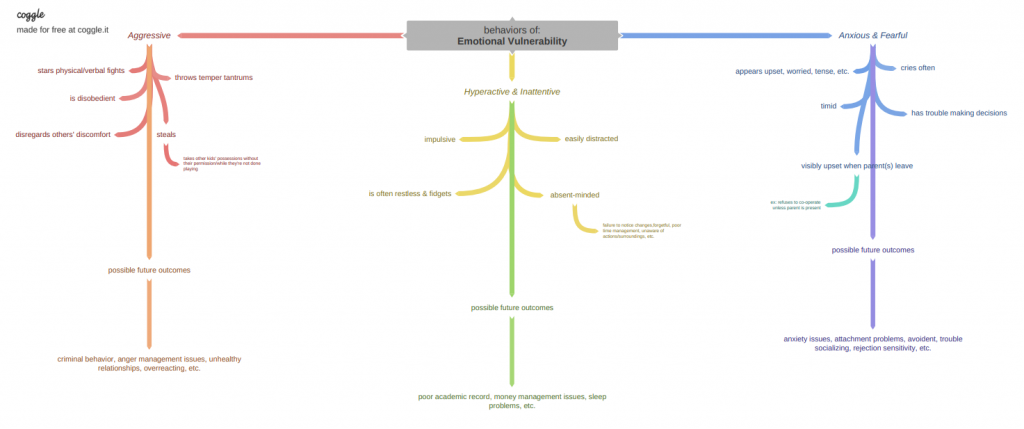
There are many programs and interventions to assist caregivers and educators in promoting healthy development for the children in their lives. A program I have found much interest in is one held in Spain, regarding how much emotional development can impact students in their academic life as well as personal.
The EDI program promotes resilience by teaching children how to understand and express their emotions through a series of highly beneficial activities for a developing brain. This program is an intervention program targeted specifically toward promoting academic achievement through improved emotional intelligence for children. Conducted by María-José Cantero, Raquel Bañus, and Paz Viguer, the study was aimed at 10-12-year-olds in Spain in two years. The EDI program took place during homeroom time and consisted of a fictional character named EDI and their journey through emotion through four
modules: intrapersonal skills, interpersonal skills, emotion regulation, and general mood (p.12).
Children were taught to recognize and apply emotions in everyday life. The writers, and conductors of the program, describe their process as “a comprehensive approach that includes experiential methodology with psychophysical, psychodrama, and systemic techniques, as well as some cognitive-behavioral techniques. The structure of the intervention
was based on techniques such as film forum, storytelling, drama, group discussion, case studies, relaxation, and music therapy. We also used techniques such as empathic stimulation, active listening, positive reinforcement, and modeling to strengthen learning.” (p. 12). The aim of to program was to see if improvement in emotional intelligence would also improve academic intelligence. According to the received data, students who attended the program scored better in language and mathematics compared to the students who didn’t participate.
References
Bañuls, R., Cantero, M. J. & Viguer, P. (2020 October 19). Effectiveness of an
Emotional Intelligence Intervention and Its Impact on Academic Performance in Spanish PreAdolescent Elementary Students: Results from the EDI Program. PubMed Central.
https://www.ncbi.nlm.nih.gov/pmc/articles/PMC7588891/
What piqued my interest in this study were my own troubles with emotion regulation and how they affected my academic life. Something as simple as having a reading break before a class to help me gather my thoughts has always been helpful, a skill I have learned perhaps a little too late for it to stick. Even in BC, the EDI provincial report shows an intriguing Wave 7 (2016 – 2019) report. Comparing Lonsdale (North Vancouver) and James Bay (Greater Victoria), the emotional vulnerability scale appears to be a little higher than average in James Bay (James Bay 21%, average in Greater Victoria 17.7%); while Lonsdale has the highest vulnerability rate compared to the rest of the neighborhoods in North Vancouver with a 36% vulnerability in a 33.4% average.
With the spread of technology and the impacts of recent events, promoting such helpful programs could strengthen the well-being of future generations.
References
Human Early Learning Partnership. EDI BC. Early Development Instrument
British Columbia, 2016-2019 Wave 7 provincial report. Vancouver, BC: University
of British Columbia, Faculty of Medicine, School of Population and Public
Health; 2019 Nov. Available from: http://earlylearning.ubc.ca/media/edibc_
wave7_2019_provincialreport.pdf
My English Final Essay Annotated Bibliography
Annotated Bibliography
• Hickey, Joseph; Davidson, Jörn. “Self – organization and time stability of social hierarchies”. 2019
This academic journal discusses social hierarchies, how and why they form and maintain stability.
• Yuval – Davis, Nira. “Review of Belonging: Solidarity and Division in Modern Societies”. 2014
This academic journal is a review of the book “Belonging: Solidarity and Division in Modern Societies”. It tackles the issue of the psychological effects of division and belonging.
• Davis, Maryann. “Youth and Young Adult Mental Health: Interventions, Services, Systems, and Rehabilitation”. 2018.
This academic journal is about education and employment supports and helping young adults with mental health problems to transition into adulthood.
• Carver, Raymond. “The Cathedral”. 1984. http://www.giuliotortello.it/ebook/cathedral.pdf
This is a short story about a man struggling to connect with his wife’s blind friend and creating a bond through drawing a Cathedral under the influence of marijuana.
• Hughes, Langston. “Theme for English B”. 1951. https://www.poetryfoundation.org/poems/47880/theme-for-english-b
This poem is about a young man talking about feeling like he doesn’t belong in a country he was born in.
• O’Brien, Tim. “The Things They Carried”. 1990.
This is a short story of army men and what they carry and how much those things mean to them.
Brida: A Magickal Journey
Many people believe that magic only exists in fairy tales and books. Many people also used to believe that witches worshipped Satan and did his bidding in exchange for supernatural powers. Both of these beliefs are not actually entirely true. Believe it or not magic, on some level, exists in our world. Obviously, I’m not talking about unicorns and Harry Potter spells. Modern witchcraft is a lot more spiritual and the redirection of energy is actually spelled “magick” here. Magick is a modern practice of spirituality and witchcraft and believe it or not, most of us practice magick without even knowing it. For example: making a wish and blowing out the candles on your birthday is actually a pagan practice, you decide on your wish and by blowing out the candle you put your wish out into the universe and congratulations! You just cast an actual spell.
I’ve always felt drawn to this side of the world, the magickal side. Growing up with Muslim parents, I always felt the need to hide that side. Always buying crystals and magick books must have given me away, my mom asked her friend to recommend me a book about the subject area, just “safer”. Because of Halloween, I was watching a series about witchcraft and it wasn’t exactly love spells and fairies so I understand why she must have got the wrong idea. When we visited Victoria, my mom’s friend recommended me “Brida”.
Brida is a book about a young Irish woman named Brida. Brida is very interested in spirituality and magick. On her journey of magick, she learns from two teachers: a wise man who teaches her “the Tradition of the Sun”, and a wise woman who teaches her “the Tradition of the Moon”. With her true intention being finding her Soulmate, she trains with them and learns the lessons of the universe. She learns to astral project her spirit to the past to see her previous lives, to mentally survive spending a night in a forest all alone without any camping gear to protect her, to dance to the song of the universe, to see visions by looking at tart cards… Brida and her teachers’ magick in this book are mostly associated with Christianity and communicating with God; although it was not my experience or the main subject of the book, I learned respect for Christianity in a different way.
This new point of view reminded me of a reading we did in our English class., “Caliban Never Belonged to Shakespeare”. The essay is written by Marcos Gonsalez and it mentions his struggle with fitting in due to his weight, sexuality, and race. He uses English literature as a tool to gain some amount of respect and power within society. Although he seems to have some interest in literature, he mainly uses his knowledge to achieve another purpose, learning literature is not precisely his priority. For Brida, magick is an amazing gift that was given to her by God, but she constantly speaks of finding her soulmate and worry about seeing that spark of light hovering over her boyfriend’s shoulder, the mark of a soulmate.
The biggest appeal for me in this book was the amazing lessons of wisdom, so I would like to end this review with a few of my favorite quotes:
‘Nothing in the world is ever completely wrong, my dear,’ said her father, looking at the clock. ‘Even a stopped clock is right twice a day.’ (Brida 99)
“She knew that no one else would listen to her with the same respect, because people were afraid of discovering that life was magical. They were used to their house, their jobs, their expectations, and if someone turned up saying that it was possible to travel in time, that it was possible to see castles adrift in the Universe, tarot cards that told stories, men who walked through the dark night, people who had never experienced such things would feel that life had cheated on them. Life, as far as they were concerned, was the same every day, every night, every weekend.” (Brida 85)
‘Why are we here? Many think they’ve found the answer in religion or in materialism. Others despair and spend their lives and their money trying to grasp the meaning of it all. A few let the question go unanswered and live for the moment, regardless of the results or the consequences. Only the brave and those who understand the Traditions of the Sun and the Moon are aware that the only possible answer to that question is I DON’T KNOW… We don’t look for an answer, we accept, and then life becomes much more intense, much more brilliant because we understand that each minute, each step that we take, has a meaning that goes far beyond us as individuals. We realize that somewhere in time and space this question does have an answer. We realize that there is a reason for us being here, and for us, that is enough.’ (Brida 171)
Works Cited
Coelho, Paulo. “Brida”. Harper Collins Publishers. 2008
Gonsalez, Marcos. “What Shakespeare’s ‘Thing of Darkness’ Tells Us About Gatekeeping and Language”. Literary Hub. 2019. https://lithub.com/caliban-never-belonged-to-shakespeare/
Hello!
Welcome to Capilano University ePortfolio Sites. This is your first post. Edit or delete it, then start blogging!