
What is Art Nouveau?
Art Nouveau, a short-lived era, had long-lasting impacts on artists and designers of contemporary society. The movement set the foundation for modern architectural designs observed in contemporary style. This blog post will detail the characteristics that influenced great architects and designers of the modern era.
Many artists from the art nouveau movement drew inspiration from the natural forms surrounding them. They often utilized florals, vines, and leaves in whimsical ways throughout their designs. Because the subject matter of their work was so organic, they had a dynamic, living feel. The use of asymmetry and sinuous lines brought their artworks and designs to life. Many of these characteristics would eventually translate into architectural creations of the time, producing breathtaking and ornate structures.

Description: an art Nouveau pattern
Title: Acanthus (1875)
Artist: William Morris
Institution: Victoria and Albert Museum, London
https://rightsstatements.org/page/InC-EDU/1.0/?language=en
Architecture and Art Nouveau
During the mid-19th century, Europe saw a rise in artists rejecting the traditional academic ways of architecture. This wave of young designers sought to use new and innovative technologies in their designs rather than stick to the old ways of building. With the industrial revolution, new materials were available; designers jumped at the chance to incorporate these novelties into their work. They often worked with glass, steel, and iron to create elegant and organic designs of the period.
Victor Horta
The first instance of using the art nouveau style in building design was by the Belgium Architect Victor Horta. A colleague had commissioned Horta to design a structure that would later be named the Tassel House. Although the outward appearance of the building followed traditional architectural style, the interior was truly unlike anything at the time. Modernist Japanese design heavily influenced the open-floor plans of the house, while Art Nouveau was responsible for the ornate decoration of the rooms. Horta used many natural shapes and curved lines throughout the ironwork that decorated the house. In addition, he used materials like steel framing and skylights to flood the open spaces with light. These materials and design style would become both a staple of his and the architects that would proceed him.
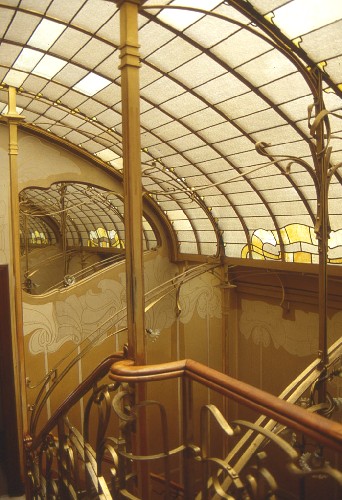
Stairway and skylight of the Horta Museum Designed by Victor Horta in Saint Gillies, Belgium
Image by Rafaelji. Original en diapositiva Kodak EKTACHROME 35 mm. – Originally from es.wikipedia; description page is/was here., CC BY-SA 3.0, https://commons.wikimedia.org/w/index.php?curid=1832725
Hector Guimard
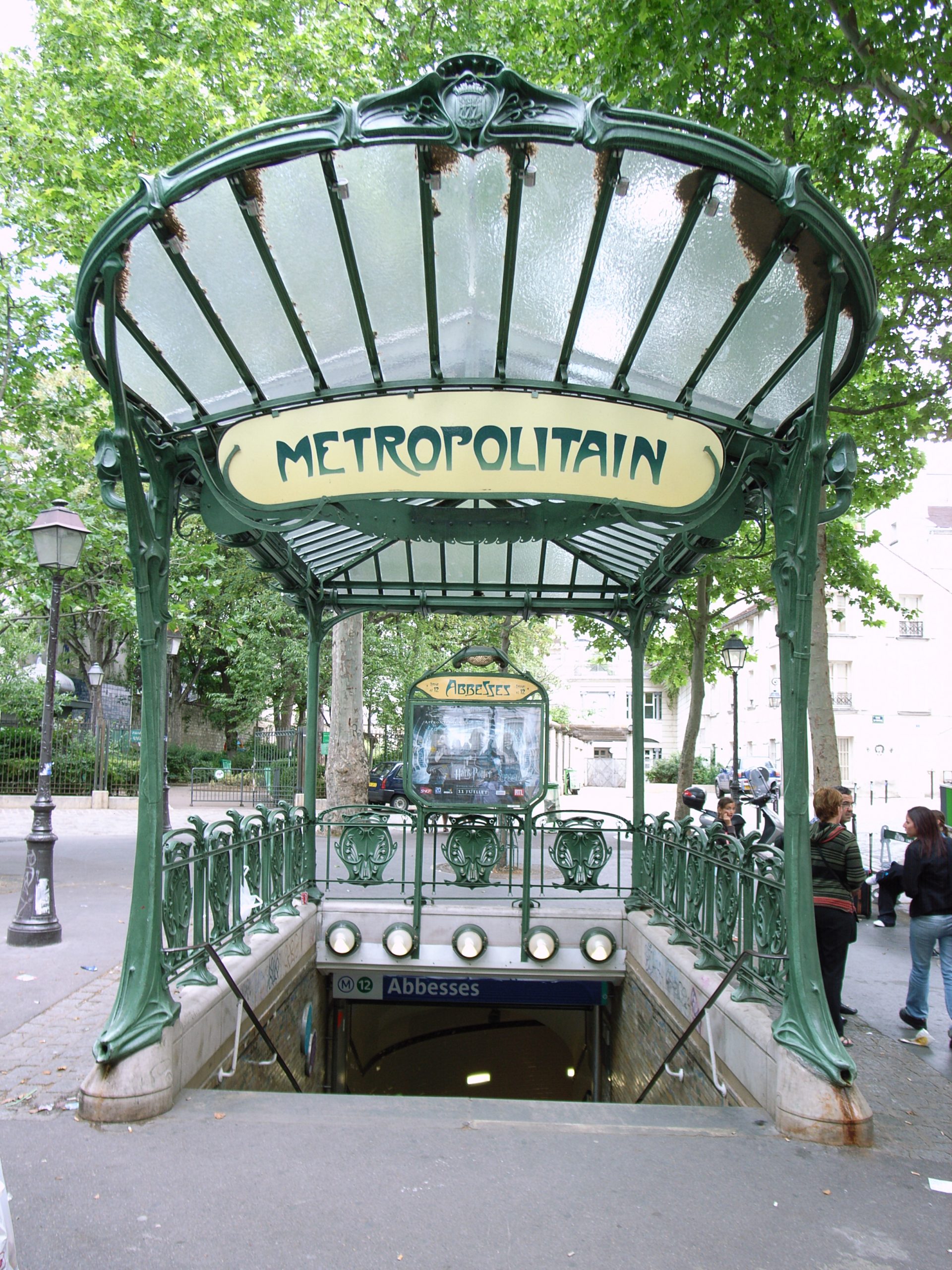
One artist that took after Horta was Hector Guimard, a French designer. His work utilized the decorative nature and curved lines that Horta popularized. Guimard set himself apart with his use of iron canopies and glass. His designs for the Paris Metro stations are infamous and notably express these staples.
Image Description
Entrance to Abbesses, Paris Metro. Art Nouveau design by Hector Guimard in Paris, France
Image Source: https://www.flickr.com/photos/stevecadman/771203797/
Author: Steve Cadman
Antoni Gaudi
Another notable architect of the period was Antoni Gaudi. His style took a fresh take on traditional Spanish architecture during the 19th century. His designs primarily used materials such as wrought iron, stained glass, carpentry and ceramics to achieve his remarkable style. Mainly his designs consisted of the natural world as well as religious motifs. Many considered him to be part of the Modernista movement in Spain. However, his creativity and innovation transcended this definition. His work created a whole new realm of architecture and shot Catalan modernism into the spotlight.
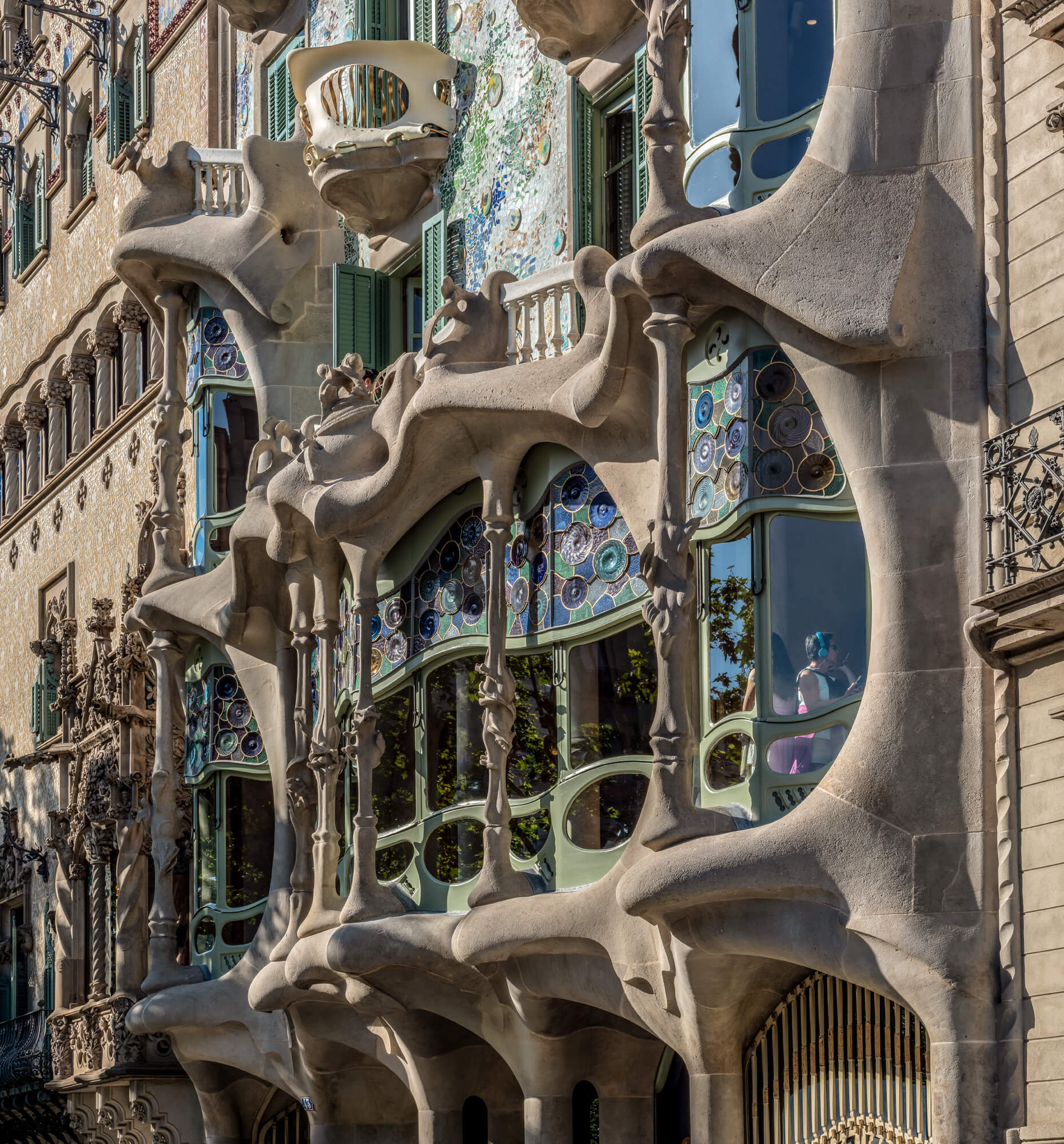
Image of the exterior of the Casa Batllo designed by Anoint Guard in Barcelona, Spain
Image Source: https://www.stirworld.com/see-features-a-look-back-at-antoni-gaudi-s-bold-and-magical-design-for-casa-batllo-in-spain
Conclusion
It’s unfortunate that the Art Nouveau period reached its peak just before the start of World War I and died down after. Not many buildings still survive from this period. As the demand for function over form increased with the rise of the modernist movement, buildings were demolished and rebuilt to fit the evolving needs of society. Nevertheless, this era was iconic and integral in inspiring future designs.
Sources
https://www.thecollector.com/victor-horta-art-nouveau-architect/
https://www.thespruce.com/what-is-art-nouveau-architecture-5194926
https://whc.unesco.org/en/list/320/
https://www.biography.com/artist/antoni-gaudi
https://whc.unesco.org/en/list/1005
https://artincontext.org/art-nouveau-architecture/
https://arthive.com/victorhorta/works/605223~Tassel_Mansion_Hotel_Tassel