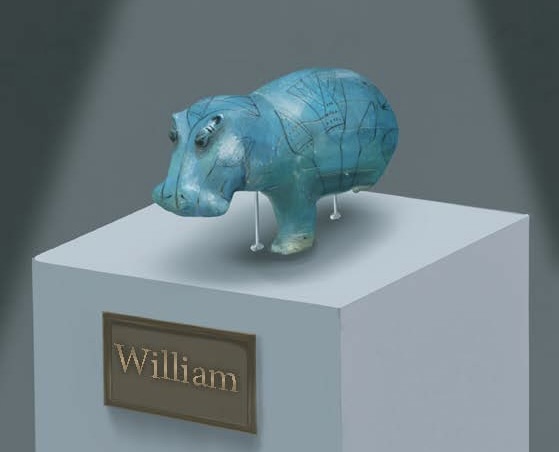
William has been with me ever since I was young. I have a children’s book about him and a stuffed plushie of him. I thought that he would be the perfect choice for this assignment because of my connection to him.
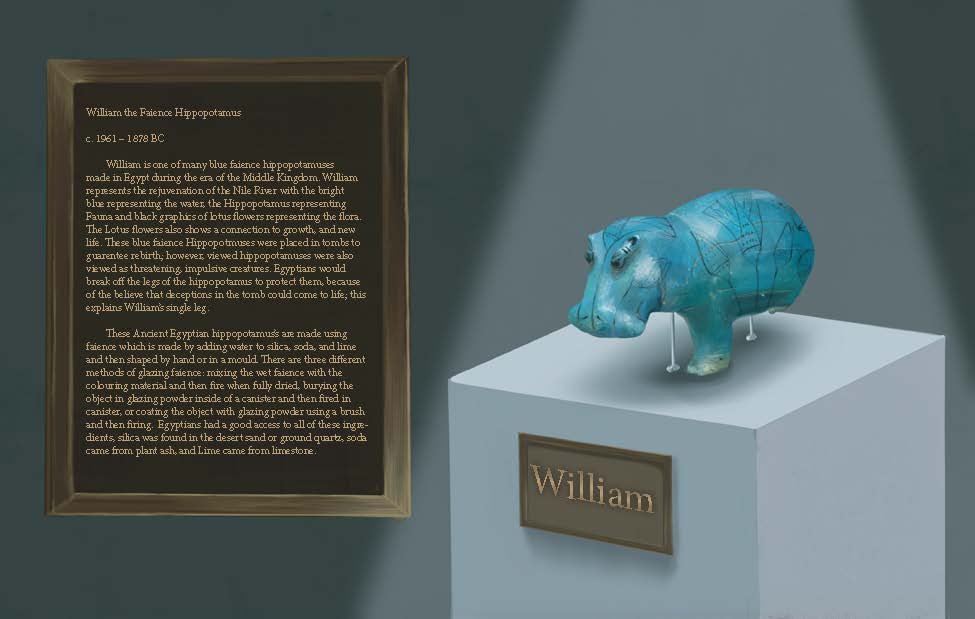
I decided that I wanted to make my design simple because I wanted the focus to be the legend himself, William. I went for a cool tone to bring out his beautiful bright blue colour. Unfortunately, I was not able to do the framing of the text and his name tag the way I had planned, because of poor time management. I spent all my time adding details to William that I couldn’t add any to the frames, resulting in awkward looking frames with awkward lighting. One of many things I learned during this assignment
I have always been into traditional art and doing William digitally was a challenge. I learned that, although procreate is amazing at not showing pixels, I need to be conscious of the size of my work because when I export the image and put it on my computer it will become blurry. All the time I spent on William’s details was turned into a blurry pixel mess.
Bibliography
Ing-Marie Back Danielsson, and Andrew Meirion Jones. Images in the Making : Art, Process, Archaeology. Manchester University Press, 2020. EBSCOhost, https://search.ebscohost.com/login.aspx?direct=true&AuthType=ip,uid&db=nlebk&AN=2591570&site=eds-live&scope=site.
Archaeology, Current World. “William the Hippo.” World Archaeology, 10 Mar. 2021, https://www.world-archaeology.com/issues/issue-87-issues/object-lesson-william-hippo/.
William the Hippo. (2018, January 25). World Archaeology. https://www.world-archaeology.com/issues/issue-87-issues/object-lesson-william-hippo/
“Seth.” Henadology, 19 Mar. 2009, henadology.wordpress.com/theology/netjeru/seth/.
“William the Faience Hippopotamus.” Wikipedia, 19 May 2021, en.wikipedia.org/wiki/William_the_Faience_Hippopotamus.
Leave a Reply