Glossary: Scott McCloud’s Understanding Comics

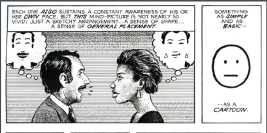
1. General placement: simple and basic features, a sketchy of arrangement, a sense of shape.

Example: each one has self-awareness about his or her own physical appearances, but this picture is not what the other look at, it just a general placement
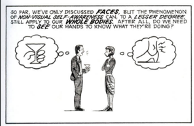
2. Non-visual awareness: people are aware of themselves, even though they cannot see what we look like.

Example: people can know their facial expression although they couldn’t see it
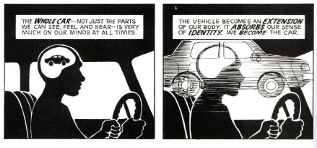
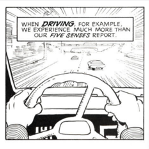
Another form of non-visual awareness is when people interact with inanimate objects. Example: like when driving, driver can receive more information beyond five senses report. The whole car became an extension of the body                                                                                        
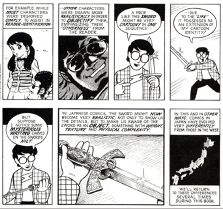
3. Objectifying power: act of treating a person, sometimes an animal as an object, empowering the character by realistic art in order to emphasizing the difference among other characters

Example: when most of characters were designed simple, some certain characters were drawn more realistically to objectify them
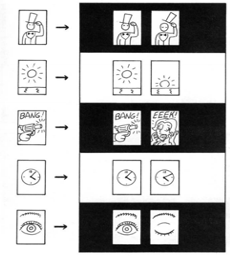
4. Sequential art: art form that use pictures in a specific sequence in order to transmit purpose of storyteller

Example:  those pictures individually just a picture, but put in a sequence of related pictures, it will show the action
Hollow | Sam Alden

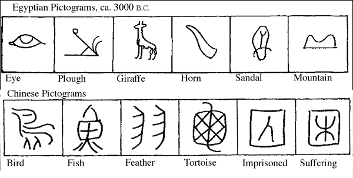
5. Pictorial: to indicate resemblance to the subject

Example: pictographs of ancient Egyptian depicts the image of the objects
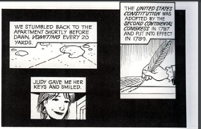
6. Word specific combination: pictures illustrate, but don’t add to a largely complete text, the using of word is to transmit the meaning of images

Example: those pictures is using box of word to transmit the message in the picture contexts
GHOST PARTY — raspberrymilk: (by Aidan Koch)

7. Picture specific combination: words play the role of soundtrack to make the sequence picture clearer

Example: words only to describe the sounds effect that make the frames become more vivid
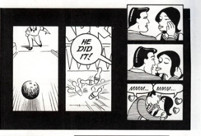
The disillusioned on Behance

8. Duo-specific panel: the use of both word and picture is to send the message in each frame

Example: Words are used to describe the sound effects, expressions, and thoughts of the characters, and the images make the reader easy to imagine
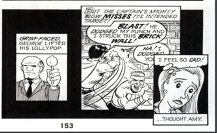
9. Montage: words become integral content of the picture

Example: The words are drawn large and heavy describing concepts that make the character tired
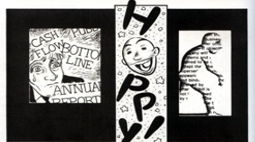


Love Comic Slides

10. Costume colour: The colour of the character’s clothes represents the character’s character. The colours were picked for strength and contrasted strongly with one another, but no colour dominated

For example, superheroes are depicted in costumes with bright primary colours, while villains are depicted in dark secondary colours.
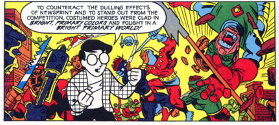
Red represent the evil

Funny Comics

Comparing between working by traditionally and digitally

     In the present era, computers have played an indispensable role in all areas of life, especially in the field of arts. Computer drawing offers certain advantages; however, hand-drawing is inherently the original form of art for thousands of year still does not lose its importance.

     When it comes to drawing with a computer, the biggest advantage it has is its editing capabilities, the mechanism of the computer that allows users to easily edit sketches with a few simple steps. Artists or designers can create different layers that overlap a drawing, edit, duplicate or change as many time as they want until come to the final work that they need. Besides, the support of the computer is also extremely useful for art that requires high accuracy such as architecture or design. During the drawing process, some time will require accuracy at an extremely high level this is really difficult or even impossible if only drawing manually. But the computer program can provide the tool for the artist to achieve, reduce the mistake of the human process

      On the other hand, Drawing is an art that requires emotion and creativity. Human hands cannot achieve pixel-by-pixel accuracy, or describe colors as accurately as they do on a computer. But the artist can still create an emotional work with just a few sketches rather than a computer drawing. Everything on the computer has been programmed and coded, neat and tidy, but creativity comes from imperfection and improvisation itself. Brushstrokes on the paper come directly from the mind of the artist base on what they think and see, while computer drawing was run through a series of binary strings, it was linear and somehow emotionless.

    In my point of view, the artwork is the combination of both accuracies of shape and color, and emotion of artist despite whatever tools you use, manual or computer. However, because of the characteristics of each type of tool, we have to focus more on either emotion or accuracy. For manual drawing, the drawing is transferred from the depicted brain through the artist’s hands, so the drawing is of the artist’s intention even when the lines may be incomplete. On the other hand, drawing on the machine means that the image is transmitted from the human brain through the technology’s brain and shows us the image that the computer’s CPU sees, which makes us have to focus more on the main description of the message that the picture brings. However, the ultimate goal of drawing is to convey the message through images, the process may be different, the way of thinking in different working processes but the end goal is constant.

     From my perspective, I still use both manual and computer tools to perfect my artwork. When I need ideas and creative inspiration, I often start from drawing sketches on paper and completing them on a computer. Overall, I still prefer drawing with the aided of computer devices. Because I can set up multiple layers to try combinations on the same work and choose the one that I like. At the same time, the color, the parameters on the computer are also more accurate, which makes it easier for me to visualize the whole picture than to do the whole work on paper.